AI Is the Intern You Cannot Afford to Hire: What It Does Well, Where It Fails
By Anis Hammouche·October 20, 2026
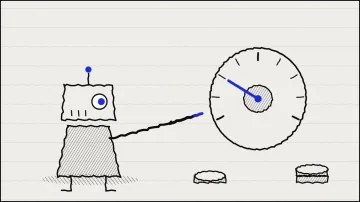
Picture this: you are a freelance photographer, your quote to a real estate agency has gone unanswered for ten days, and you ask AI to write the follow-up. It hands you a clean email in seconds, knowing nothing about that client or how you work. It acts like a very fast intern who has never practised your trade: brief it like one, and review its work the way you would review theirs.
Why the image holds
An intern needs supervision, but they bring speed and availability. At first they know nothing about your company, they need instructions, and they make mistakes a senior spots in two seconds. They are also more comfortable with tightly framed tasks than with decisions about direction.
AI shares these traits. It does not keep your context from one conversation to the next, unless your tool stores it or you give it again. It does not know that your client hates long emails. It has no experience of your market. And it does not say "I don't know" as readily as an honest person would. Researchers, including Adam Tauman Kalai of OpenAI, argue that evaluation procedures often reward a guessed answer over an admission of uncertainty (Kalai et al., arXiv preprint, 2025).
What it does well
- First drafts: an email, an outline for an offer, a plan for an article. You get the starting point, not the final result.
- Rewording: turning a technical text into a simple version, or the reverse.
- Summaries of documents you provide: a contract, minutes, a transcript. For a document you give it, the output can be reliable, provided you check it.
- Lists and variations: ten titles, five angles, three ways to say no.
- Formatting: tables, structure, consistency across several texts.
These tasks share one feature: you can judge the result in seconds, and the error is visible.
Where it fails
The study by Fabrizio Dell'Acqua and his co-authors (2023), carried out with consultants at the Boston Consulting Group, shows the scale of the problem. On tasks inside AI's "frontier", consultants who used it were faster and more productive. On a task chosen outside that frontier, consultants using AI were 19 percentage points less likely to give the correct answer. The frontier is uneven: two tasks that look equally hard can fall on opposite sides (Harvard Business School).
In practice, AI often fails at:
- precise facts and figures without a source (see the article on hallucinations);
- the rules of your trade that it does not know, such as the mandatory mentions on a freelancer's invoice or the customs of your profession;
- situations you did not describe to it, because it fills gaps with the most common answer;
- decisions that commit money or reputation, where one error costs more than the time saved.
To see that proofreading on one specific task, read how to check every price and every condition in a quote.
How to brief it
A good brief for AI looks like a good brief for an intern. It has four blocks:
Mission: write a follow-up for a quote sent 10 days ago.

Context: I am an independent photographer. My client is a real estate
agency. They have not replied, and I do not want to rush them.

Success criteria: 4 sentences maximum, no excessive politeness formulas,
one closed question to make the reply easy.

Format: a single email text, no title. At the end, flag any point you
could not verify, for example a date.
The last instruction matters. Asking the AI to flag its doubts does not remove them, but it tells you where to look. It guarantees nothing.
What you always review
You do not need to read everything with the same care. But some outputs always need checking.
| Type of task | Level of confidence | Review |
|---|---|---|
| First draft of an email or text | High for form | Check tone and substance |
| Summary of a document you provide | Good, except details | Check figures and names |
| Figure, date, law, source | Low without checking | Open the original source |
| Legal, tax or medical advice | Not enough on its own | Refer to an official source or a professional |
| Commitment to a client | Depends on the case | Read every line as if you had written it |
Frequently asked questions
Can AI really replace an intern?
It takes over part of the tasks you would give an intern. It does not replace supervision, or judgement about what matters to your client. Part of the time saved is often spent on review and framing.
Do you have to correct the AI every time?
For a repeated task, correct it once and keep the instruction. Your brief improves with each correction, as it would with an intern who is learning.
Which task should you hand over first?
A repetitive task that is easy to judge, with no direct legal or financial stake. A first draft of an email is a good test.
Stuck on a specific case? Write to me via the contact page.